Addressing Unmet Peri-Operative Support Needs in Breast Surgery: Findings from a Patient Survey
The team at Plexāā is proud to share that our latest research into peri-operative support needs in breast surgery was selected for presentation at the London Breast Meeting 2026. This internationally attended conference gave us the opportunity to share our findings with leading surgeons and specialists, and to continue building the case for structured, patient-centered preoperative support.
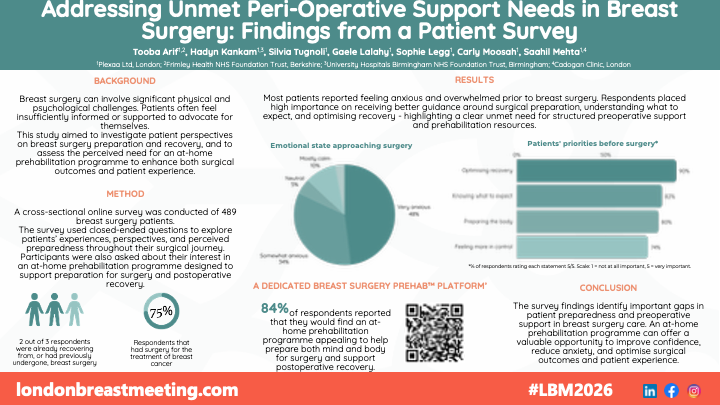
A summary of our work can be found in the article below.
Why we did this research
Breast surgery can involve significant physical and psychological challenges, and patients often feel insufficiently informed or supported to advocate for themselves. This study aimed to investigate patient perspectives on breast surgery preparation and recovery, and to assess the perceived need for an at-home prehabilitation programme to enhance both surgical outcomes and patient experience.
What patients told us
We conducted a cross-sectional online survey of 489 breast surgery patients from all over the world, exploring their experiences, perspectives and perceived preparedness throughout their surgical journey. Three-quarters (75%) of respondents had undergone surgery for the treatment of breast cancer, and two out of three were already recovering from, or had previously undergone, breast surgery.
The results showed that
Most patients reported feeling anxious and overwhelmed approaching surgery, with 48% describing themselves as "very anxious" and a further 34% "somewhat anxious." Only 10% felt mostly calm.
When asked about their priorities before surgery, patients placed high importance on optimizing their recovery (90%), knowing what to expect (82%), preparing the body (80%), and feeling more in control (74%).
These findings point to a clear, unmet need for structured preoperative support and prehabilitation resources.
The case for an at-home Prehab™ platform
These results reinforce something we've long believed: patients want more than reassurance, they want practical, structured guidance to help them prepare, both physically and mentally, in the lead-up to surgery.
84% of respondents said they would find an at-home prehabilitation program appealing, to help prepare both mind and body for surgery and support postoperative recovery.
Moving forward
This research adds to the growing evidence base behind BLOOM⁴³, and reinforces why we built the platform the way we did: to give patients structured, accessible support to help them feel more confident, less anxious, and better prepared, well before they reach the operating room.
The survey findings identify important gaps in patient preparedness and preoperative support in breast surgery care. An at-home prehabilitation program can offer a valuable opportunity to improve confidence, reduce anxiety, and optimise surgical outcomes and patient experience. We’re pleased to be able to offer the BLOOM⁴³ app as a free resource to help patients prepare for breast surgery.
About Plexāā
Plexāā is a pioneering UK MedTech company focused on improving surgical outcomes through innovative solutions. Their flagship device, BLOOM⁴³, enables patients to supraphysiologically precondition their skin, potentially reducing the risk of wound healing complications such as infection and skin necrosis, which affect 1 in 3 women undergoing breast surgery.
BLOOM⁴³ is the world's first fully wearable device worn next to the skin before breast surgery. By gently warming the area, it stimulates the release of Heat Shock Proteins (HSPs), naturally occurring proteins that trigger the release of carbon monoxide into the tissue. This vasodilates the blood vessels and improves blood flow to the skin, priming it to heal, an effect shown to help prevent wound healing complications in proof-of-concept clinical trials.
Plexāā is also exploring the application of this technology in other surgical fields, including obstetrics for C-sections, orthopedics for joint operations, and general and vascular surgery, with a commitment to improving pre-operative preparation for surgery and patient outcomes.